For simple November nails, start with solid coffee brown, burgundy, forest green or gray. If you want a detail, keep it to one accent nail on each hand. You can use the same palette on short nails without adding length or buying a nail-art kit.
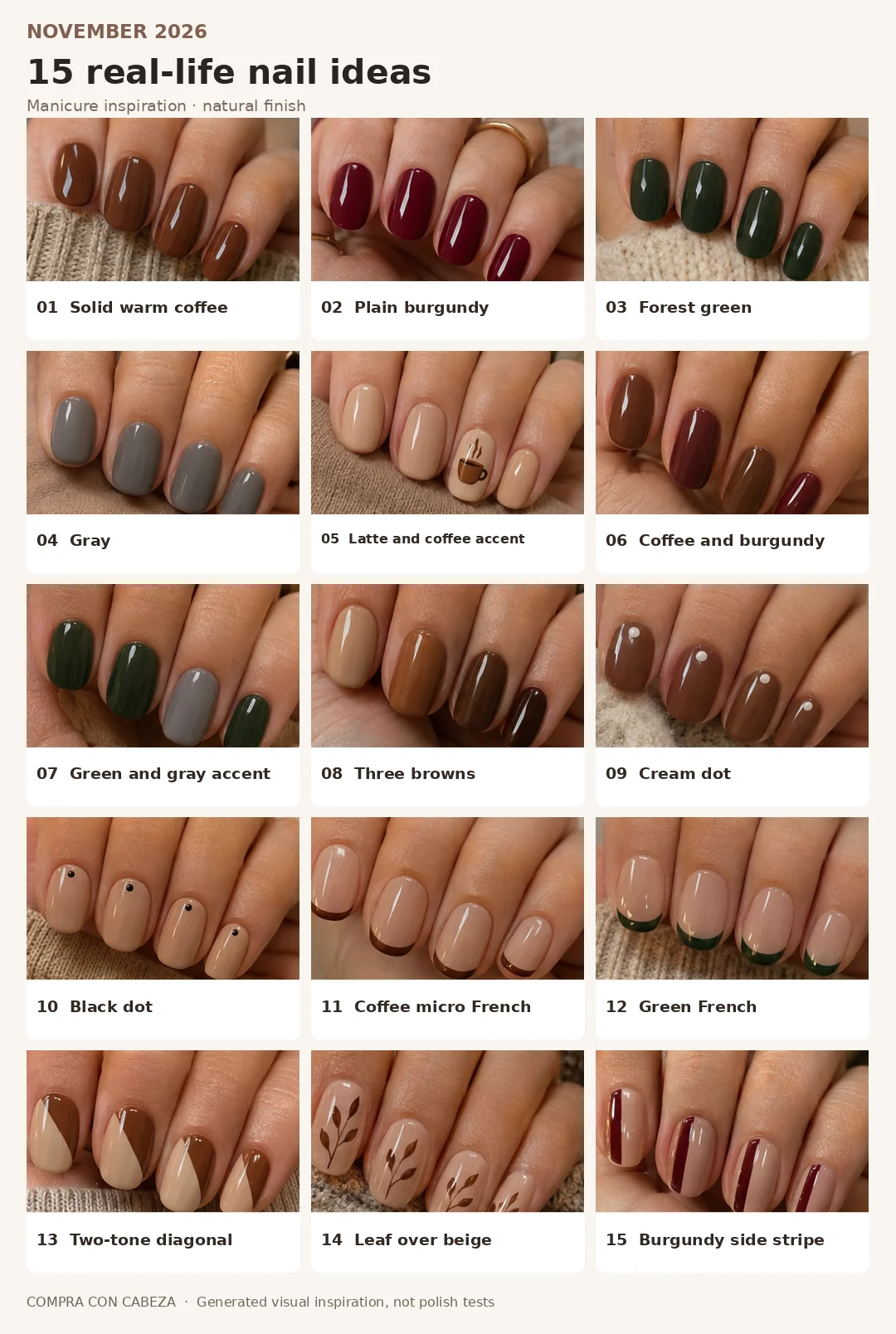
These 15 ideas separate color choices from gestures that need more control. Here, “elegant” means our preference for fewer colors and details, rather than a rule about what you should wear. The diagrams show layouts, not photographs of manicures we have tested.
Choose a design by the gesture it needs
Ideas 1–8 use whole-nail color. Ideas 9–15 add a dot, edge or motif. “Short with an edge” means the tip needs visible space; use the simpler option if it takes over the nail. Difficulty compares the gestures, not the speed or performance of a polish.
| No. and idea | Layout | Length | Relative difficulty | Simpler option |
|---|---|---|---|---|
| 1. Solid warm coffee | Medium warm brown throughout | Very short or short | Low: one color | Repeat one suitable shade you own |
| 2. Plain burgundy | Dark berry red throughout | Very short or short | Low: one color | Leave out decorative glitter |
| 3. Forest green | Deep green throughout | Very short or short | Low: one color | Keep the green without leaves |
| 4. Gray for the season change | Gray throughout | Very short or short | Low: one color | Use an existing gray before seeking another undertone |
| 5. Latte with a coffee accent | Four beige nails and one brown ring finger per hand | Very short or short | Low: two colors | All coffee brown if you have no beige |
| 6. Coffee and burgundy | Alternate two colors in the same order on both hands | Very short or short | Low: color placement | One burgundy ring finger instead |
| 7. Green with a gray accent | Four green nails and one gray ring finger | Very short or short | Low: two colors | Keep the whole hand green |
| 8. Three browns | Repeat beige, medium brown and deep brown | Very short or short | Low: three colors | Use two shades without mixing formulas |
| 9. Brown with a cream dot | One cream dot on the brown ring finger | Short | Moderate: placement | Make that accent nail cream throughout |
| 10. Burgundy with a dark dot | One black dot on the burgundy ring finger | Short | Moderate: contrast and placement | A whole black accent nail |
| 11. Coffee micro French | A narrow brown tip over a neutral base | Short with an edge | Moderate: repeating a curve | Solid brown if the edge is uneven |
| 12. Green French | Deep green tips over a neutral base | Short with an edge | Moderate: controlling the tip | One whole green accent nail |
| 13. Two-tone diagonal | Beige and brown divided on one accent nail | Short | Higher: a defined boundary | A whole brown ring finger |
| 14. A leaf over beige | One brown leaf on the thumb, other nails beige | Enough space for the motif | Higher within this selection: several strokes | A dot, or the whole-nail layout in idea 5 |
| 15. Burgundy side stripe | Gray base with a narrow stripe on one ring finger | Short | Higher: a straight edge | A whole burgundy accent nail |
For a first attempt, choose one of the first eight. A small French tip can be harder to repeat than a full dark nail, especially with your less confident hand.
What you need for the layout you chose
For every option, use the preparation, finish and removal products specified by your exact polish system. The diagram cannot tell you whether a formula dries in air or requires documented curing equipment.
| Ideas | Color and detail materials | What you can leave out |
|---|---|---|
| 1–4 | One suitable color | Second shades and detail tools |
| 5–7 | Two colors with compatible instructions | A fine brush or dotting tool |
| 8 | Two or three suitable shades, kept in their own bottles | A full gradient set |
| 9 | Brown, cream and a manicure dotting tool | The dotting tool if you choose a whole cream accent |
| 10 | Burgundy, black and a manicure dotting tool | The tool if you choose a whole black accent |
| 11–12 | Neutral, tip color and a suitable detail brush | Extra decorative motifs |
| 13–15 | Base and detail colors, plus a suitable fine brush | The brush if you switch to whole-nail color |
You do not need to buy every color in the chart. Start with what you already have and choose one composition. A “latte” name alone does not identify a formula or an exact shade across brands.
A first layout: latte with a coffee accent
Idea 5 uses two colors without a drawn motif. Before painting, assign beige to the thumb, index, middle and little finger, and brown to the ring finger on each hand.
- Check the instructions for the exact colors and their preparation, finish and removal products. Keep formulas separate.
- Apply each shade to the fingers you selected, following its application and drying directions.
- Repeat the arrangement on the other hand. If you only have brown, use idea 1 rather than buying a second shade just to complete the layout.
The arrangement is what this guide explains. We have not measured application time, coverage or wear, and there is no drying time that applies to every polish.
If you want a dot or a French tip
For idea 9, practice placing one cream dot with a suitable manicure tool before repeating it on the other hand. Keep enough brown visible around it. If the dot becomes too large, a whole cream accent preserves the contrast without requiring that gesture.
For idea 11, keep a neutral base visible beneath the coffee tip. Try the curve on one nail before committing to all ten. A longer nail gives you more room, but does not make the two hands symmetrical. If the curve is frustrating, use a brown accent nail instead.
Idea 14 needs several strokes to make the leaf recognizable. Choose it if you want to practice that drawing, or take it as a reference to a manicure appointment. A dot is a simpler alternative; it will give a different motif in the same colors.
Choose a color before choosing a product
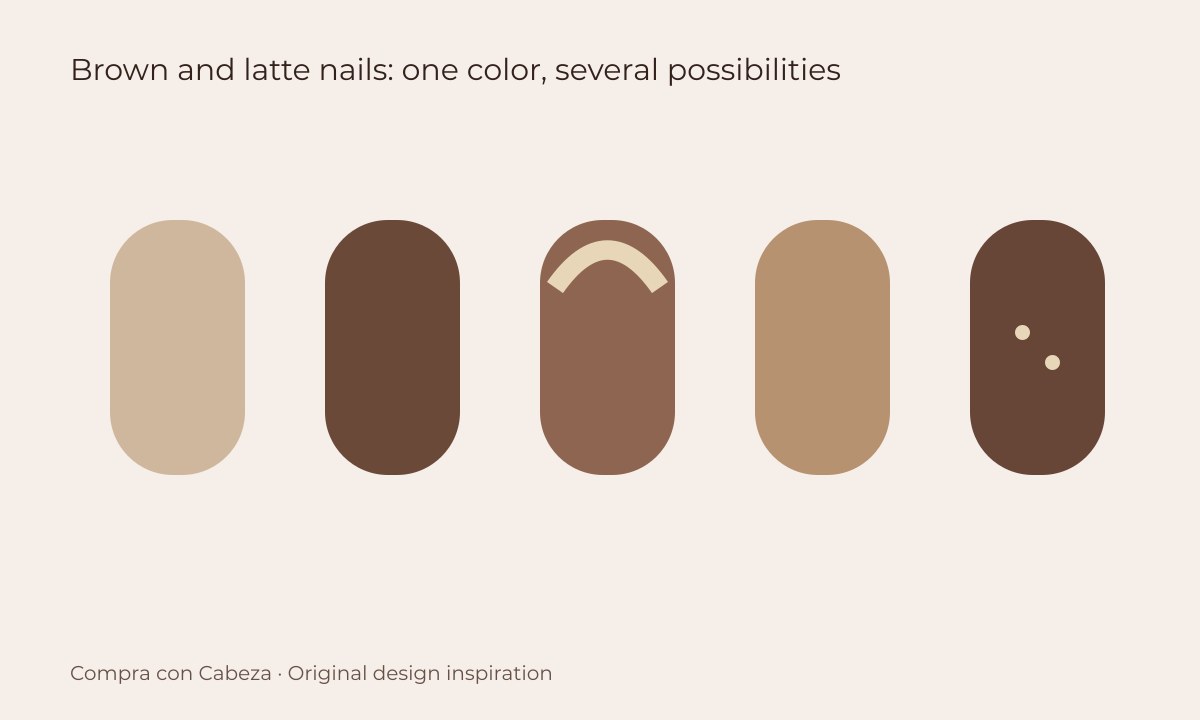
The brown and latte nail guide compares lighter, medium and deep brown compositions. For dark red, our Essie Wicked analysis explains why a very deep burgundy differs from cherry red. The Off Tropic analysis covers a forest-green candidate.
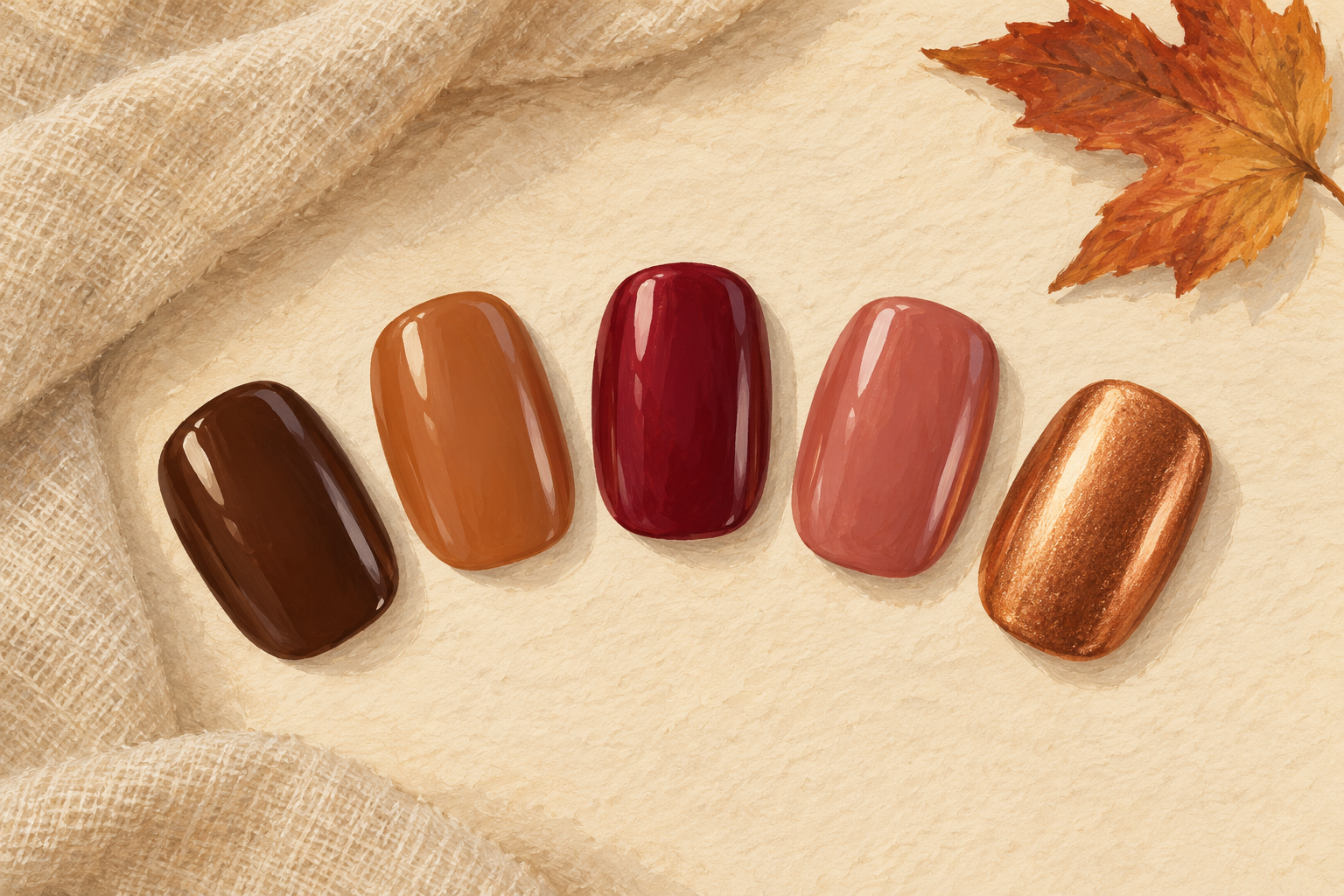
Those pages help identify a color direction. They do not establish that a specific bottle will match these diagrams under your lighting. Keep a suitable polish you own if it already gives you the color and routine you want. A copper metallic accent would change the finish of these layouts; it is not needed for any of the 15 ideas.
November, Thanksgiving or Christmas?
Keep this selection for everyday November color choices. If you want to choose a palette for the holiday dinner, the Thanksgiving nail guide offers chocolate, caramel, cranberry, rose terracotta and copper, with its own design selection. You can also choose a Thanksgiving style in five questions.
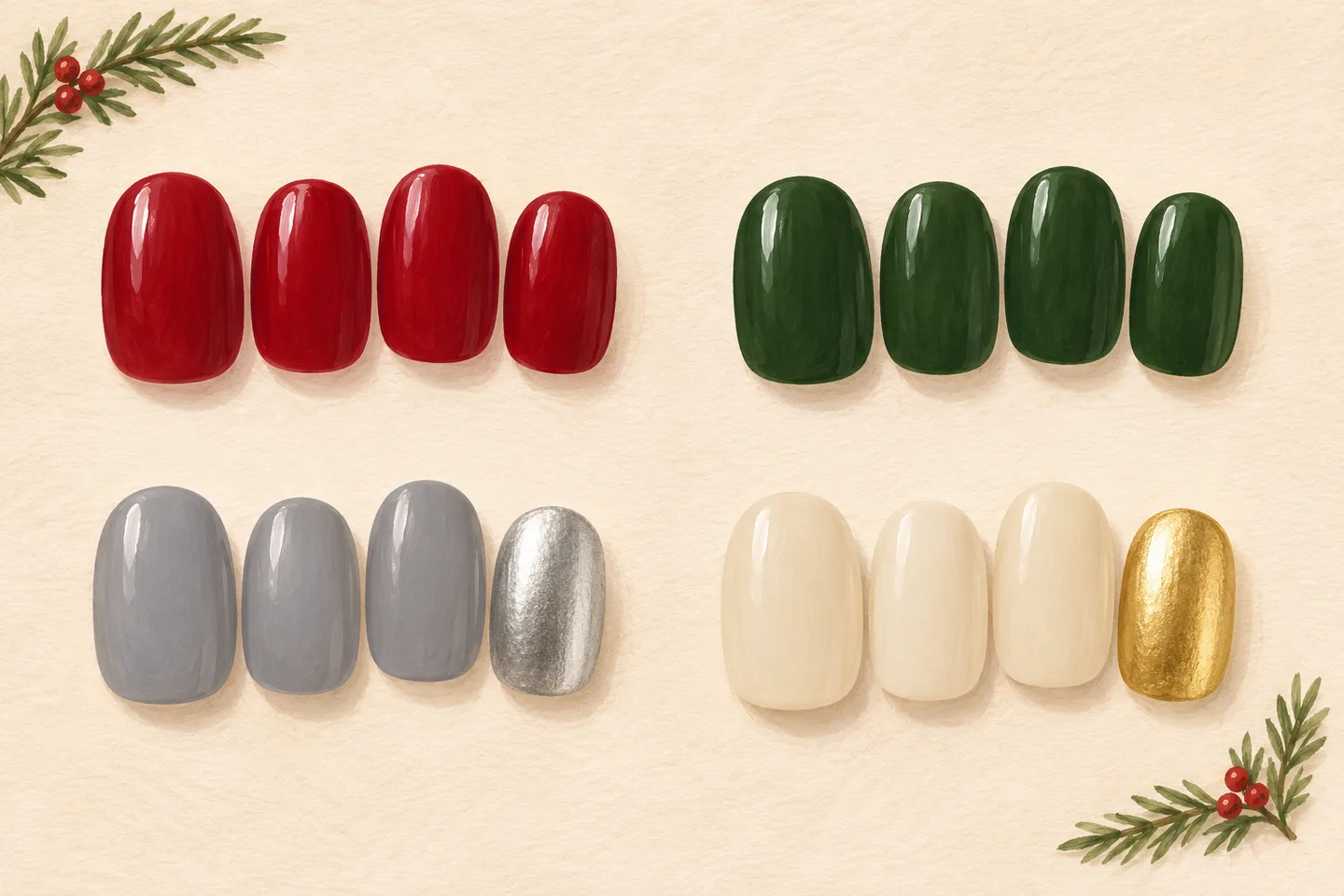
For festive red, green, silver or gold, continue to Christmas nail ideas. Use the occasion to choose the detail you want, rather than buying a new system for a single look.
Questions before you start
Which November nails need the least drawing?
Ideas 1–8 use whole-nail color placement. One color needs fewer materials than two or three; choose the palette you already have if you want to avoid another purchase.
Can I keep my nails very short?
Yes. The solid-color and whole accent-nail layouts do not depend on a visible free edge. For a French tip, leave enough base visible or switch to the solid-color alternative.
Does this include a floral or tortoiseshell tutorial?
The 15 numbered options cover the layouts shown in the diagram. Flowers, tortoiseshell, foil and raised sweater textures need different instructions and are outside this selection.